
Where is Pune’s education market moving next?

Pune Education Market · Market Perspective · September 2026
For decades, Pune’s education story was relatively easy to understand.
The city had established schools, respected colleges, a large student population and a reputation strong enough to attract families and students from across Maharashtra and India.
That foundation has not disappeared.
What is changing is the market around it.
Pune is no longer one education market. It is becoming a collection of increasingly distinct education clusters — shaped by where families live, what they are willing to pay for, the curriculum they prefer, and what they expect an institution to deliver beyond the classroom.
For education leaders, that makes the next growth decision more complicated.
The question is no longer simply:
“Is Pune a good market?”
It is:
“Where in Pune is the right market for us — and what should we offer there?”
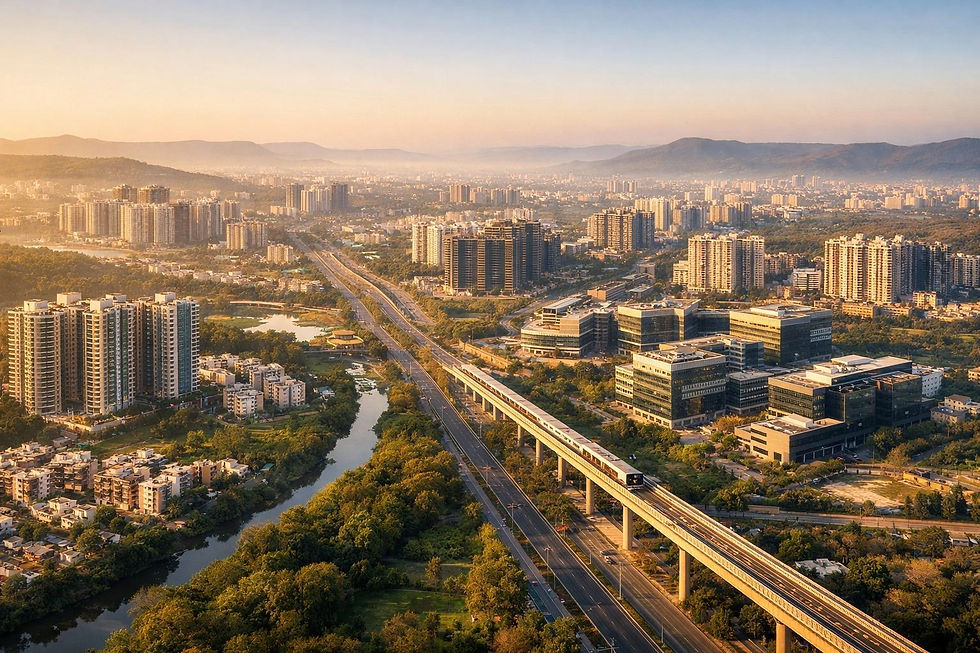
Pune already has scale. That changes the growth question.
The starting point is the size of the existing ecosystem.
One 2026 market mapping of Pune district identifies 434 CBSE, ICSE and Cambridge school affiliations: 354 CBSE, 53 ICSE and 27 Cambridge CAIE. The same dataset reports a median disclosed annual fee of approximately ₹1 lakh across the mapped market.
The higher-education ecosystem is larger still. The same analysis, drawing on the AISHE higher-education directory, identifies 763 higher-education institutions in Pune district — 32 universities and 731 colleges. Of those colleges, 586, or roughly 80%, are classified as private unaided institutions.
These numbers matter because they change the nature of competition.
Pune does not suffer from a lack of institutions.
It has abundance.
And in an abundant market, adding another institution, programme or campus does not automatically create demand.
The strategic challenge becomes differentiation.
1. Private education is not a niche segment
This is not simply a Pune phenomenon.
Across India, UDISE+ recorded approximately 95.9 million students in private unaided recognised schools in 2024–25, from pre-primary through Class 12. Of these, nearly 39.8 million were in Classes 1–5, 21.7 million in Classes 6–8, 13.1 million in Classes 9–10, and 11.1 million in Classes 11–12.
Maharashtra alone had 14,284 private unaided recognised schools with a primary section in 2024–25; 7,393 of these reported pre-primary sections.
For Pune’s private institutions, this has an important implication.
Parents are already accustomed to evaluating private education as a choice.
That means institutions increasingly compete not only on whether they provide education, but on what kind of educational proposition they provide.
Curriculum, academic outcomes, student development, teacher quality, infrastructure, university pathways, career exposure, technology, sports and extracurricular opportunities all become part of the decision.
A school therefore cannot rely indefinitely on location and academic results alone.

2. International curricula are moving further into the mainstream
One of the clearer signals is the expansion of international curricula.
Cambridge International reported that the number of Cambridge schools across South Asia increased from 894 in 2023–24 to 1,034 in 2024–25 — growth of 16% in a single year.
India accounted for more than 81% of the new additions, and more than 75% of Cambridge schools in South Asia are now located in India.
Pune has a particularly interesting place in that story.
Bramhapriya World School in Pune became Cambridge's 1,000th school in South Asia.
The Pune-specific market mapping cited earlier identifies 27 Cambridge CAIE affiliations in the district.
This should not be interpreted as every parent suddenly wanting an international curriculum.
It suggests something more useful.
The range of what Pune families consider credible schooling is widening.
CBSE remains significantly larger in absolute presence. But international curricula are creating another competitive reference point for parents — particularly around flexibility, skills, global pathways and the overall learning experience.
That affects even institutions that have no intention of becoming Cambridge or IB schools.
Because expectations can move faster than curriculum affiliations do.
3. The market is becoming more segmented by price
Pune's education market is also becoming harder to describe using labels such as simply “premium” and “affordable.”
The 2026 Pune market dataset shows substantial variation.
Its indicative annual fee ranges include:
₹1.9–2.8 lakh for the premium CBSE segment,
₹0.8–1.9 lakh for mid-premium CBSE,
and approximately ₹2.2–7 lakh for Cambridge CAIE institutions in the dataset.
The exact fee charged by an individual institution can of course differ materially depending on grade, transport, admission charges and other services.
The strategic point is the spread itself.
A family considering a ₹60,000 school and one considering a ₹3 lakh school may technically belong to the same geographic education market, but they are not necessarily buying the same proposition.
Their expectations, alternatives and decision criteria can be very different.
That means institutions need to be clearer about which part of the market they actually intend to serve.
Trying to be premium in communication, mid-market in fees and mass-market in delivery can create an institution that is difficult for parents to understand.
4. Geography may matter more than city-level market size
Pune's growth has produced education catchments that behave differently from one another.
The western technology corridor around Hinjawadi–Wakad, established areas of Pune city, the eastern employment and residential belt, PCMC and emerging peripheral locations do not necessarily have the same household profile, competitive density or education requirements.
The existing school footprint already illustrates this dispersion.
CBSE's official affiliation directory, for example, records independent senior-secondary schools in locations including Hinjawadi, Wakad, Moshi and Undri, among many other parts of Pune district.
This matters when institutions consider expansion.
A city-level statistic can tell a governing body that Pune is attractive.
It cannot tell them whether a new campus should be in Wakad, Baner, Kharadi, Ravet, Moshi, Undri or another micro-market.
For that decision, the institution needs a different level of analysis:
Who lives within the realistic catchment?
Which schools are already competing for those families?
What are parents currently paying?
Which curricula are available?
Where is residential development moving?
What would make a family switch?
The answers can change within a relatively short distance.
5. More programmes will not necessarily mean more growth
Higher education shows the same competitive pressure from another direction.
Pune district's 731 colleges and 32 universities create enormous programme availability. More importantly, approximately 80% of the colleges in the cited AISHE-based dataset are private unaided institutions. citeturn2view1
That makes programme expansion relatively easy to understand but harder to execute successfully.
Institutions can add programmes.
Students, however, still need a reason to choose them.
A recent example shows how portfolios continue to evolve: in September 2026, Dnyaan Prasad Global University in Pune announced new BBA in Culinary Arts, MBA in Hospitality Management and Diploma in Hospitality Management programmes for the 2026 academic session.
The broader lesson is not that hospitality is the next opportunity.
It is that institutions are continuing to build more specialised portfolios.
As programme choice expands, a generic degree proposition becomes harder to defend.
Institutions increasingly need to answer:
Why this programme?Why from us?
What outcome does it lead to?
And why should a student choose it over the alternatives already available?
6. Pune's employment economy will increasingly influence education choices
Education strategy cannot be separated from the economy surrounding it.
Pune continues to strengthen its position in technology, engineering, professional services and Global Capability Centres. Recent commercial-market reporting points to GCCs as a major contributor to Pune's office demand, supported in part by the city's existing skilled-talent base.
For universities and autonomous institutions, the connection is direct.
Programme portfolios, industry partnerships, internships, applied learning and employability propositions need to evolve alongside the city's economy.
For schools, the relationship is less immediate but still important.
Parents increasingly evaluate education through a longer lens: not simply the next examination, but the capabilities their children will need later.
That raises the value of communication, problem-solving, technology exposure, career exploration and independent thinking alongside academic performance.
What does this mean for institutional leaders?
The numbers point towards a market that is large, private-sector-led in important segments, increasingly diverse and already highly supplied.
That changes how growth should be approached.
For an established school, the right move may be strengthening its proposition rather than immediately opening another campus.
For an autonomous institution, it may be redesigning programmes around emerging demand rather than simply adding more courses.
For a school group considering expansion, the opportunity may exist — but at the level of a particular catchment, fee band or curriculum proposition, not “Pune” as a whole.
And for institutions already facing admissions pressure, more marketing may not solve a proposition problem.
The first question should therefore not be:
“How do we grow admissions?”
It should be:
“Where do we have the right to grow?”
That requires understanding the intersection of market demand, geography, competition, pricing, institutional capability and future relevance.
Only then does growth become an execution question.
The next opportunity may be smaller — and more specific — than it looks.
Pune remains one of India's most important education centres.
But its next phase is unlikely to be defined simply by more schools, more colleges or more programmes.
It will be shaped by institutions making sharper choices.
Which students will we serve?
Which geography gives us an advantage?
Which programmes deserve investment?
Where are parents' and students' expectations moving?
And what can our institution credibly do better than the alternatives already available?
Those are harder questions than deciding whether Pune is an attractive education market.
They are also the questions that matter more.
Because in a market with hundreds of schools and more than 700 colleges, growth does not begin with expansion.
It begins with knowing where the market is moving — and deciding where your institution should move with it.
About this perspective
This NT&C Market Perspective draws on publicly available information including UDISE+ 2024–25, the CBSE SARAS affiliation directory, Cambridge International Education, AISHE-referenced institution data and publicly reported 2026 market information.
Pune-specific school counts cited above refer to the identified CBSE, CISCE and Cambridge affiliations in the referenced market dataset and should not be interpreted as the total number of all schools operating in Pune district, since Maharashtra State Board and other institutions are outside that particular count.
NT&C · Precision • Purpose • Pivot
